
Elizabeth Fulhame, a Forgotten Chemistry Pioneer | Physics Today
“It wasn’t unusual for women in the 18th and 19th centuries to receive a basic science education, take an interest in the latest scientific advances, and dabble in practical experimentation. But the idea that women could develop new theories and advance the field of science was well beyond societal expectation.”
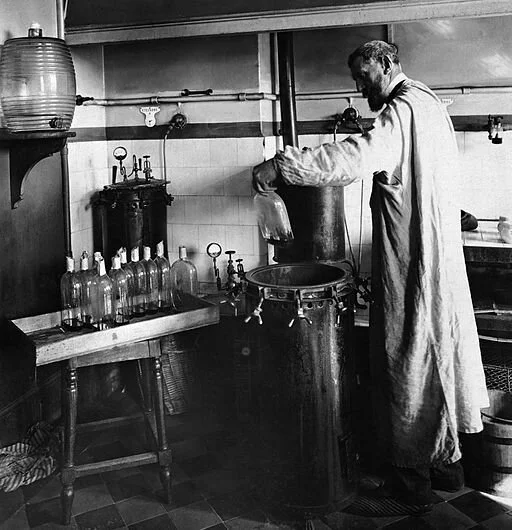
Early Life | Louis Pasteur (1822-1895)
“But those who would decorate the early years of Louis Pasteur with wonderful legends would be disappointed: when a little later he attended the daily classes at the Arbois college he belonged merely to the category of good average pupils.”

On Mary King Ward, 19th-Century Celebrity Scientist | LitHub
“The morning of her death, Ward had just written to her publisher to say that she didn’t want to reprint her Telescope Teachings book. Her reason: in the decade since its first printing, it had become “altogether behind the present state of the subject—I am desirous it should be a useful book and in no-wise out of date for 1870.”

The Last Love of Jonas Salk | Nautilus
“She had no interest in meeting him—she thought scientists were boring. But soon afterward, he came to New York and invited her to have tea at Rumplemayer's. “He didn't have tea; he ordered pistachio and tangerine ice cream,” she recalls. “I thought, Well, a scientist who orders pistachio and tangerine ice cream at five o'clock in the afternoon is not like everybody else!” Sourced from Vogue /Life After Picasso

Early Life | Michael Faraday (1791-1867)
“We know little of his schooling there could, indeed, be little to know and in 1804, at the age of 13, he was engaged as an errand boy at a bookseller's shop in Blandford Street. Newspapers in those days were expensive articles and, except by the very wealthy, were hired, and not bought. One part of Faraday's duties was to take out these papers to the different borrowers, and to collect them when the allotted number of hours had expired.”

Wings of Desire / Nikola Tesla's Fantastic Secret | Cabinet Magazine
“By 1921, Tesla was even bringing some pigeons back to his room at the St. Regis hotel, providing basket nests near open windows so that his guests could come and go as they pleased. After a while, “great flocks of them would come to his windows and into the rooms, and their dirt on the outside of the building became a problem to the management and on the inside to the maids.”

Radical Solutions | Damn Interesting
“The story of Évariste Galois—a revolutionary in every sense—has become something of a legend in the last 150 years, not least because of the dual figure he presents as mathematical visionary and political lightning-rod. Early obituaries all focused on him as a republican. As early as 1846, however, Liouville could dismiss Galois’s political activities as nothing more than “a pity”, and for several decades this was the common verdict. Neither of these is the full story.”.

Annus Mythologicus | The Renaissance Mathematicus
“It is justified to ask where then does the myth of the Annus Mirabilis actually come from? The answer is Newton himself. In later life he claimed that he had done all these things in that one-year, the fictional ones rather than the real achievements. So why did he claim this? One reason, a charitable interpretation, is that of an old man just telescoping the memories of his youth. However, there is a less charitable but probably more truthful explanation.”
The Wild Ones | the Atavist Magazine
“They were risking their lives—everyone in the group was clear about that. They just weren’t in agreement on why. Was it for publicity or for plants? News wires picked up the Michigan Daily story, and each retelling was more sensationalized than the last. The “relic flora” and “important cacti” mentioned in the original article became “botanical freaks” in an Associated Press story. Eventually, nothing much was said about science at all. One reporter noted, “The women, besides their scientific work, will do the cooking.” Articles described “Miss” Clover as a 40-year-old college professor, plump and bespectacled, while Jotter was thin, freckle-faced, and nearly six feet tall. Indignant, Jotter corrected that description whenever she could: She was five feet seven and a half inches.”

Early Life | James Clerk Maxwell | 1831-1879
“In still earlier childhood, when he returned from walking with his nurse, she had generally a lapful of curiosities (sticks, pebbles, grasses, etc.) picked up upon the paths through the wood, which must be stored upon the kitchen dresser till his parents had told him all about each one.”

Early Life | William Ramsay | 1852-1916
“From notes supplied by Miss Flora Mac Vicar and Mrs. McNicol, early friends of the family, we know that young Ramsay had a very happy childhood and youth, though in some respects the circumstances surrounding his life were different from those of other boys.”

Early Life | Eleanor Anne Ormerod | 1828 -1901
“I was born at Sedbury Park, in West Gloucestershire, on a sunny Sunday morning (the nth of May, 1828), being the youngest of the ten children of George and Sarah Ormerod, of Sedbury Park, Gloucestershire, and Tyldesley, Lancashire.”

Early Life | Mary Somerville |1780-1872
“When I was between eight and nine years old, my father came home from sea, and was shocked to find me such a savage. I had not yet been taught to write, and although I amused myself reading the "Arabian Nights/' "Robinson Crusoe," and the " Pilgrim's Progress," I read very badly, and with a strong Scotch accent .

Early Life | Jean-Henri Fabre |1823-1915
“The conclusion is positive: there is nothing in heredity to explain my taste for observation. You may say that I do not go far enough back. Well, what should I find beyond the grandparents where my facts come to a stop? I know, partly. I should find even more uncultured ancestors: sons of the soil, plowmen, sowers of rye, neat herds; one and all, by the very force of things, of not the least account in the nice matters of observation. And yet, in me, the observer, the inquirer into things began to take shape almost in infancy. “

Early Life | Carl Friedrich Gauss |1777-1855
“While still very young Gauss showed rare mental gifts. He learned to read by asking one or another in the home the sound of the letters. His marked aptitude for numbers and his ease and accuracy in mental arithmetic soon attracted the attention of his parents and their friends. He used to say jestingly that he learned to count before he could talk.”

Early Life | Joseph Fourier |1768-1830
Fourier was born at Auxerre on the 21st of March, 1768. His father, like that of the illustrious geometer Lambert, was a tailor. This circumstance would formerly have occupied a large place in the éloge of our learned colleague; thanks to the progress of enlightened ideas, I may mention the circumstance as a fact of no importance: nobody, in effect, thinks in the present day, nobody even pretends to think, that genius is the privilege of rank or fortune.