Mummies Among Us | Aeon
“For most of the history of European collection of mummies, the primary thing Europeans did with them was grind them up. At first, Europeans ate them – mummies were considered a drug. ‘Mummie is become Merchandise, Mizraim cures wounds, and Pharaoh is sold for balsams,’ as Browne wrote.”
Read the Article
Addendum
“Another anecdote is dated to 1866 and is very short on verifiable information.
The editor of the Bunker Hill Aurora said, that a few Sundays before, he heard a clergyman, in illustrating a point in his discourse, state that during the late war, a New York merchant at Alexandria, in Egypt, having occasion to furnish a ship with a freight homeward, was led, partly through fear of pirates, to load her with mummies from the famous Egyptian catacombs. On arriving here, the strange cargo was sold to a paper manufacturer in Connecticut, who threw the whole mass, the linen cerement, the bitumen and the poor remains of humanity, into the hopper, and had them ground to powder. “And”, added the speaker, “the words I am now reading to you, are written on some of this paper.”
Elliott, Chris (2017). "Bandages, Bitumen, Bodies and Business - Egyptian mummies as raw materials". Aegyptiaca: Journal of the History of Reception of Ancient Egypt. 1: 26-46. Retrieved Sep 9 2020.
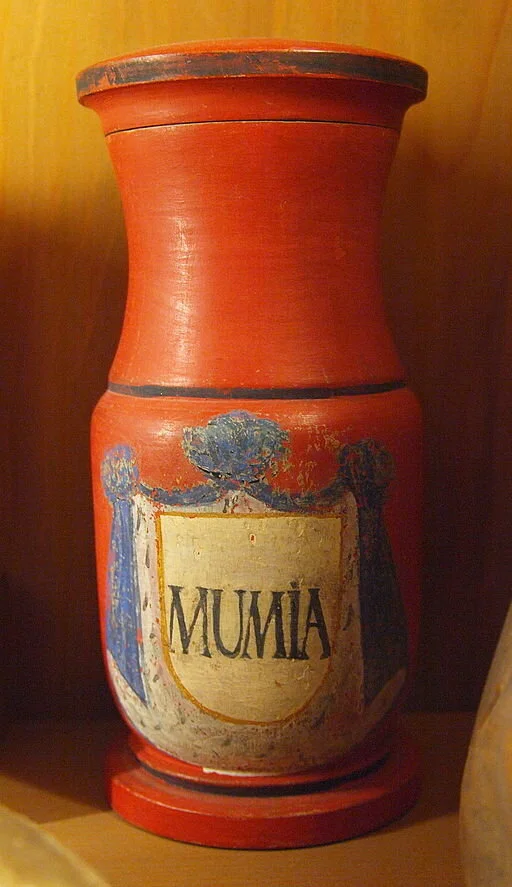
Apothecary vessel (albarello) with inscription (MUMIA) dating to 18th century at Deutsches Apothekenmuseum Heidelberg, Germany/ Wikipedia Commons /Bullenwächter / CC BY-SA (https://creativecommons.org/licenses/by-sa/3.0)