Early Life | Thomas Alva Edison ( 1847-1931)
The Lake Shore Railway having injured the trade of Milan, the family removed to Port Huron, in Michigan, when Edison was about seven years old. Here they lived in an old-fashioned white frame-house, surrounded by a grove, and commanding a fine view of the broad river, with the Canadian hills beyond. His mother undertook his education, and with the exception of two months he never went to school. She directed his opening mind to the acquisition of knowledge, and often read aloud to the family in the evening. She and her son were a loving pair, and it is pleasant to know that although she died on April 9, 1871, before he finally emerged from his difficulties, her end was brightened by the first rays of his coming glory. Mr. Edison tells us that his son never had any boyhood in the ordinary sense, his early playthings being steam-engines and the mechanical powers. But it is like enough that he trapped a woodchuck now and then or caught a white-fish with the rest. He was greedy of knowledge, and by the age of ten had read the Penny Encyclopedia ; Hume's History of England ; D'Aubigne's History of the Reformation ; Gibbon's Decline and Fall of the Roman Empire, and Sears' History of the World. His father, we are told, encouraged his love of study by making him a small present for every book he read. At the age of twelve he became a train-boy, or vendor of candy, fruit, and journals to the passengers on the Grand Trunk Railway, between Port Huron and Detroit. The post enabled him to sleep at home, and to extend his reading by the public library at Detroit. Like the boy Ampere, he proposed, it is said, to master the whole collection, shelf by shelf, and worked his way through fifteen feet of the bottom one before he began to select his fare. Even the Principia of Newton never daunted him ; and if he did not understand the problems which have puzzled some of the greatest minds, he read them religiously, and pressed on. Burton's Anatomy of Melancholy, Ure's Dictionary of Chemistry, did not come amiss ; but in Victor Hugo's Les Miserables and The Toilers of the Sea he found a treasure after his own heart. Like Ampere, too, he was noted for a memory which retained many of the facts thus impressed upon it, as the sounds are printed on a phonogram. The boy student was also a keen man of business, and his pursuit of knowledge in the evening did not sap his enterprises of the day. He soon acquired a virtual monopoly for the sale of newspapers on the line and employed four boy assistants. His annual profits amounted to about 500 dollars, which were a substantial aid to his parents. To increase the sale of his papers, he telegraphed the headings of the war news to the stations in advance of the trains and placarded them to tempt the passengers. Ere long he conceived the plan of publishing a newspaper of his own. Having bought a quantity of old type at the office of the Detroit Free Press he installed it in a springless car, or ‘caboose' of the train meant for a smoking-room, but too uninviting to be much used by the passengers. Here he set the type and printed a small sheet about a foot square by pressing it with his hand. The Grand Trunk Herald, as he called it, was a weekly organ, price three cents, containing a variety of local news, and gossip of the line. It was probably the only journal ever published on a railway train ; at all events with a boy for editor and staff, printer and ‘devil,' publisher and hawker. Mr. Robert Stephenson, then building the tubular bridge at Montreal, was taken with the venture, and ordered an extra edition for his own use. The London Times correspondent also noticed the paper as a curiosity of journalism. This was a foretaste of notoriety. Unluckily, however, the boy did not keep his scientific and literary work apart, and the smoking-car was transformed into a laboratory as well as a printing house. Having procured a copy of Fresenius' Qualitative Analysis and some old chemical gear, he proceeded improve his leisure by making experiments. One day, through an extra jolt of the car, a bottle of phosphorus broke on the floor, and the car took fire. The incensed conductor of the train, after boxing his ears, evicted him with all his chattels.
Excerpted from Heroes of the Telegraph by J. Munro, publication date 1891, digitized by Google, Public Domain USA . Online at archive.org
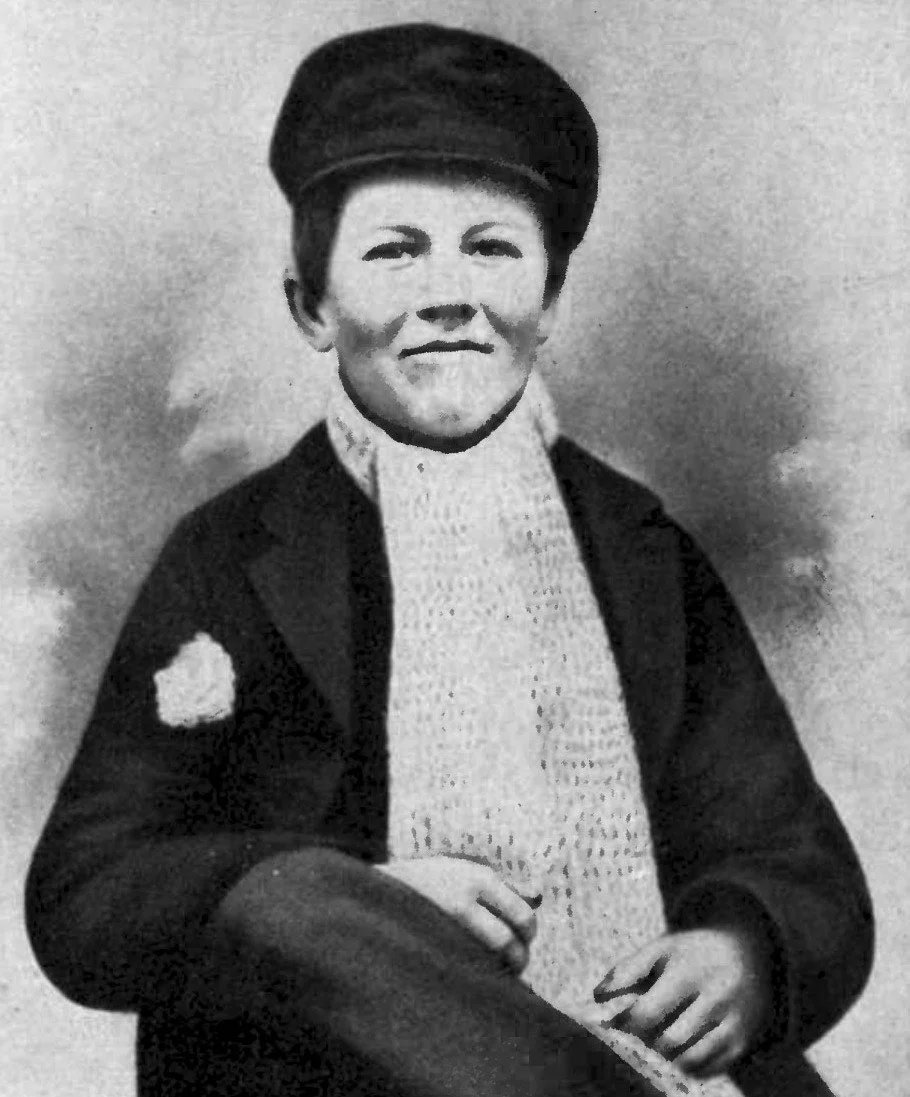
Edison as a boy, 1861 Unknown Author, Public Domain USA
“Thomas Alva Edison (February 11, 1847 – October 18, 1931) was an American inventor and businessman.
He developed many devices in fields such as electric power generation, mass communication, sound recording, and motion pictures. These inventions, which include the phonograph, the motion picture camera, and early versions of the electric light bulb, have had a widespread impact on the modern industrialized world.[5] He was one of the first inventors to apply the principles of organized science and teamwork to the process of invention, working with many researchers and employees. He established the first industrial research laboratory.
Excerpted from Wikipedia